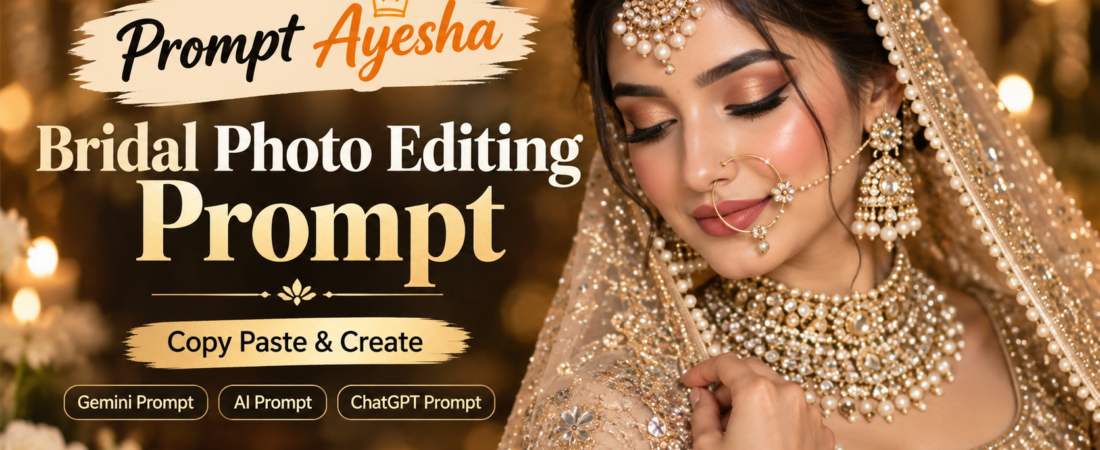
Want to create a luxurious, cinematic bridal portrait with an elegant Indian wedding look? This bridal photo editing prompt is designed to create a highly detailed South Asian bride wearing a champagne-gold and ivory bridal lehenga, traditional jewelry, a sparkling dupatta, and soft glam makeup.
The overall concept focuses on a premium Indian bridal editorial style with warm golden lighting, realistic skin texture, detailed embroidery, and a dreamy wedding atmosphere. If you’re looking for a Gemini prompt for creating a sophisticated bridal image, the following guide will help you achieve this kind of visual direction.
In this comprehensive article, we will explore the exact prompt, explain why each element matters, and share expert tips for getting the most realistic and stunning results possible.
Understanding the Bridal Portrait Concept
The bridal portrait is one of the most cherished forms of photography in South Asian culture. It captures not just the beauty of the bride, but also the richness of tradition, the intricacy of craftsmanship, and the emotion of one of life’s most important moments.
Creating a convincing AI-generated bridal portrait requires attention to multiple elements working in harmony. The prompt combines several components that are important for creating a premium bridal portrait. Instead of focusing only on the outfit, it describes the complete visual composition, including jewelry, makeup, hairstyle, pose, lighting, background, and photography style.
The champagne-gold and ivory color combination gives the bride a sophisticated appearance while the sequins, crystals, pearls, and embroidery add richness to the outfit. The sheer dupatta also creates a soft layered effect around the face and shoulders, adding depth and texture to the image.
Why Attention to Detail Matters
AI image generation has come a long way in recent years, but it still requires precise instructions to produce truly premium results. When you simply ask an AI to create “a bride,” you will likely get a generic result that lacks cultural authenticity and visual richness.
However, when you provide detailed descriptions of each element—from the specific type of jewelry to the exact style of makeup—you guide the AI toward creating something that feels authentic and sophisticated. This is the difference between a basic AI-generated image and one that could pass for professional editorial photography.
The Complete Bridal Photo Editing Prompt
Copy the prompt below exactly when creating the image:
Create an ultra-realistic cinematic close-up portrait of a beautiful South Asian bride wearing an elegant champagne-gold and ivory heavily embellished bridal lehenga. She is draped in a luxurious sheer glittering dupatta over her head and shoulder, decorated with intricate sequin, crystal, and pearl embroidery with a delicate pearl border.
She is wearing luxurious traditional Indian bridal jewelry, including a large pearl-and-gold maang tikka, oversized intricate jhumka earrings, a heavily detailed layered gold-and-pearl choker necklace, and a delicate large gold nath with pearl embellishments. Add elegant stacked bridal bangles.
Her makeup is soft glam bridal makeup with glowing dewy skin, warm peach-pink blush, champagne-gold shimmer eyeshadow, dramatic black winged eyeliner, long natural lashes, neatly defined eyebrows, and muted rose-red lipstick. Her dark hair is sleek and elegantly styled beneath the veil, with a few soft strands naturally framing her face.
Pose: intimate close-up three-quarter portrait, face slightly turned downward and toward the camera, eyes gently closed, serene and graceful expression, one hand delicately holding the edge of the sparkling dupatta near her shoulder.
Lighting: warm golden cinematic lighting, soft diffused glow across the face, subtle candle-like bokeh lights in the background, dreamy luxurious wedding atmosphere, beautiful highlights reflecting from the jewelry and sequins, shallow depth of field.
Style: photorealistic high-end Indian bridal editorial photography, natural facial features, realistic skin texture, highly detailed jewelry and embroidery, realistic fabric texture, cinematic composition, 85mm portrait lens, creamy background bokeh, professional studio photography, soft warm tones, ultra-detailed, 8K quality.
No text, no captions, no watermark, no logos, no UI elements.
What Makes This Bridal Prompt Special
Creating a truly exceptional AI-generated bridal portrait requires more than just listing items. It requires understanding how each element contributes to the overall mood and quality of the final image.
The Color Palette
The champagne-gold and ivory color combination is not accidental. These colors are associated with luxury, elegance, and celebration in South Asian weddings. Champagne-gold suggests warmth and radiance, while ivory provides a clean, sophisticated backdrop that allows the gold tones to shine.
This palette also works well with warm golden lighting, creating a cohesive visual experience where everything feels intentional and harmonious.
The Jewelry Description
Another important element is the jewelry. The maang tikka, jhumkas, choker, nath, and bangles are described individually so the generated image can capture the traditional bridal aesthetic with greater detail.
Each piece of jewelry plays a specific role in the composition:
-
Maang Tikka: Draws attention to the forehead and frames the face beautifully
-
Jhumka Earrings: Add movement and sparkle on either side of the face
-
Choker Necklace: Creates a focal point at the neckline and adds layering
-
Nath (Nose Ring): A traditional element that adds cultural authenticity
-
Stacked Bangles: Add texture and visual interest to the hands and arms
When you describe each piece individually rather than just saying “traditional jewelry,” the AI can generate more accurate and detailed results.
The Lighting Description
The lighting description also plays an important role. Warm golden illumination combined with candle-like bokeh helps create an intimate wedding atmosphere instead of a flat studio-style image.
Lighting is often the element that separates a good image from a great one. In this prompt, the lighting instructions serve multiple purposes:
-
Warm Golden Light: Creates a romantic, luxurious mood
-
Soft Diffused Glow: Flatters the skin and creates a dreamy quality
-
Candle-like Bokeh: Adds atmosphere and depth to the background
-
Highlights on Jewelry: Makes the jewelry sparkle and feel three-dimensional
Tips for Getting a More Realistic Bridal Result
When using an AI prompt for image creation, detailed descriptions can help establish the overall visual direction. However, the final result can still vary depending on the image-generation model, reference image, and settings being used.
Here are some practical tips to maximize your chances of getting a stunning, realistic result:
Use a High-Quality Reference Image
For a more natural-looking portrait, use a clear and well-lit reference photograph when your AI tool supports image references. Avoid heavily filtered or extremely low-resolution reference images because facial details may not transfer as naturally.
The reference image should show the person’s face clearly, with even lighting and minimal shadows. This allows the AI to capture the true facial features and maintain identity consistency.
Experiment with Aspect Ratios
You can also experiment with different aspect ratios depending on where you want to use the image. A portrait-oriented format can work well for Instagram posts, Pinterest graphics, profile-style portraits, and mobile wallpapers.
The 9:16 ratio works particularly well for mobile-first content, while a 4:5 or 1:1 ratio might be better for traditional social media posts.
Keep the Focus on the Face
For a close-up bridal composition, keeping the face as the main visual focus can help preserve the editorial photography effect. The jewelry, veil, and embroidery should complement the face rather than overpower it.
If you find that the generated image has too much happening in the frame, try reducing the complexity of the jewelry description or simplifying the background elements.
Why Cinematic Bridal Portraits Look So Premium
Cinematic bridal photography is not only about adding more jewelry or making the outfit more detailed. The combination of lighting, depth of field, composition, fabric texture, skin details, and background atmosphere creates the premium appearance.
The Role of Depth of Field
In this concept, the soft golden light highlights the bride’s face while the background remains intentionally blurred. This creates separation between the subject and the environment.
The shallow depth of field also produces creamy bokeh around the bride, giving the portrait the appearance of professional photography captured with a portrait lens. This technique is widely used in wedding photography to create a dreamy, intimate feel.
The Importance of Realistic Skin Texture
The realistic skin texture is equally important. An overly smooth face can make an AI-generated image look artificial, while subtle natural skin details can make the final portrait feel more photographic.
When AI models “beautify” faces by removing all texture, the result often feels uncanny and unnatural. By requesting “realistic skin texture” in the prompt, you encourage the AI to preserve natural details like pores, subtle highlights, and gentle shadows.
How to Use This Prompt Effectively
You can copy the complete prompt above and paste it into your preferred AI image-generation platform. If the platform allows you to upload a reference image, you can add one according to its available image-reference features.
Here is a step-by-step approach to get the best results:
-
Prepare Your Reference Image: Choose a clear, well-lit photo that shows the person’s face clearly.
-
Copy the Prompt: Use the exact prompt provided above without modification.
-
Set the Aspect Ratio: Choose a portrait-oriented format for the best results.
-
Generate Multiple Versions: Create several variations to see which one works best.
-
Review and Refine: Look for any issues like extra fingers, distorted jewelry, or unnatural lighting. Adjust the prompt if needed.
Troubleshooting Common Issues
After generating the first result, you can experiment with the image settings while keeping the main prompt unchanged. Try different portrait dimensions and reference-image strengths to see how they affect the final composition.
If the first generation does not produce the desired jewelry or outfit details, generating another variation can often produce a closer result. AI-generated images may interpret specific details differently from one generation to another.
If you’re using this concept with ChatGPT, keeping the visual instructions together rather than adding unrelated descriptions can help maintain a consistent creative direction.
Frequently Asked Questions
Q: Can I use this bridal prompt with different AI image generators?
Yes. The prompt is written as a detailed visual description and can be adapted to different AI image-generation platforms. The exact output may vary between tools, but the core principles apply universally.
Q: Can I use a reference photo with this prompt?
If your selected AI platform supports image references, you can use a suitable reference image. Follow the platform’s own rules regarding uploaded images and identity references.
Q: How can I make the bridal image look more realistic?
Use a high-quality reference image when supported, avoid excessive facial filters, and keep the lighting and photography instructions detailed. Multiple generations may also help you find a more natural result.
Q: What type of image is this prompt designed to create?
It is designed for a close-up, three-quarter South Asian bridal portrait with cinematic lighting, traditional Indian bridal jewelry, an embellished lehenga, and a luxurious wedding atmosphere.
Q: Can I use this prompt for social media?
Yes. You can generate a suitable portrait-oriented version for platforms such as Instagram, Pinterest, Facebook, or other visual-content platforms, depending on the platform’s requirements.
Final Thoughts
A beautiful bridal portrait depends on the balance between traditional styling and modern cinematic photography. This concept combines an elegant champagne-gold bridal outfit, detailed Indian jewelry, glowing makeup, a sparkling veil, warm lighting, and a graceful pose to create a luxurious wedding-inspired portrait.
Whether you’re creating a personal bridal-style image, experimenting with AI photography, or exploring new visual ideas for social media, this prompt provides a detailed starting point. Prompt Ayesha brings together creative image-generation ideas that can help you explore different photography styles and concepts.
Remember that AI-generated results can vary depending on the platform and reference image you use. Experiment with different generations while keeping the core visual concept consistent. With practice and patience, you will be able to create stunning bridal portraits that capture the beauty and elegance of Indian wedding traditions.
Did you find this guide helpful? Share it with someone who might benefit from it. Have questions or want to share your results? Leave a comment below and join the conversation!