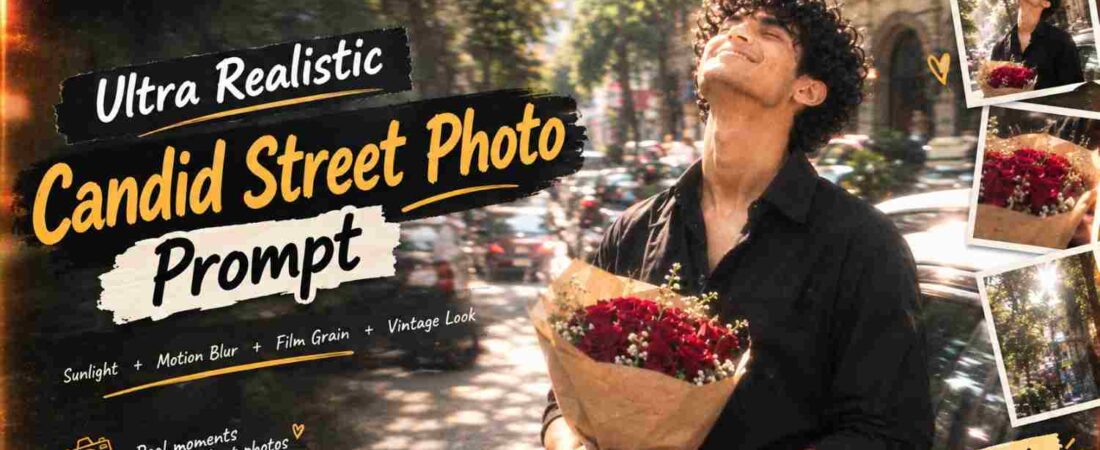
Some photographs feel special simply because they don’t look planned. A quick smile, sunlight falling across someone’s face, a bouquet held casually in both hands, and a little motion blur can make a picture feel like a genuine memory.
This concept is built around that kind of spontaneous moment. If you’re looking for a ChatGPT prompt for a realistic street photograph, this one aims for an image that feels naturally captured rather than carefully posed or digitally polished.
The scene shows a young South Asian man standing beside a parked white car, holding a bouquet of deep red roses. His head is tilted back toward the sunlight, his eyes are closed, and he looks genuinely happy. Add bright daylight, trees, parked cars, old building details, grain and slightly faded colors, and you get the feel of a nostalgic snapshot someone took without thinking twice.
What Makes This Photo Style Special?
The main appeal is that it’s imperfect. Instead of a razor-sharp portrait under studio lights, this style leans on motion blur, lens softness, smeared edges, bloom and imperfect focus. The result looks like something grabbed quickly on an older digital camera, the kind of photo you’d find in a phone gallery from years ago and suddenly realize you love.
The vertical 9:16 format also suits modern social media. It leaves enough room for the man, the bouquet, the car, the trees and the street around him, and it fills a phone screen nicely.
The goal is a photo from an ordinary day when something unexpectedly happy happened.
The Pose Creates the Emotion
The pose is what makes the image feel candid. He stands beside the white car, leaning slightly back, with his head tipped far toward the sun. His eyes are shut tight and he has a broad, closed-mouth smile, the kind people get when they’re laughing at something and not thinking about the camera at all.
Because he isn’t looking at the lens, the picture feels like a stolen moment rather than a posed shot. This kind of pose also works well in natural outdoor light. His face catches the sun while the street around him stays softer and less controlled.
The Bouquet Adds Character
The deep red roses are one of the strongest visual elements in the scene. They’re wrapped in plain brown kraft paper and held naturally in both hands. The dark red petals stand out against his black shirt and trousers, and the brown paper adds a warm, earthy tone.
Try not to make the bouquet look too perfect. A slightly loose, natural arrangement keeps the candid feeling intact. It also gives him something real to hold, so he doesn’t look like he’s just standing there for the camera.
A Busy Street Makes the Scene Believable
The background is deliberately not a clean studio. A tree-lined city street, parked cars and old building arches create the sense of a real place. They provide context without stealing attention from the man.
Sunlight filtering through the trees adds dappled shadows. Some areas of the background are brighter and softer, others are a little darker. That uneven mix is exactly what keeps the photo from looking staged.
Why Motion Blur Works
Real photographs aren’t always sharp. When a subject moves, or the camera shifts slightly during the exposure, parts of the picture go soft. In this concept, that softness is the point. The flowing movement around him, combined with lens softness and smeared edges, gives the photo a spontaneous feel.
There’s a balance to strike, though. You still want to recognize the pose and the emotion. If the blur is too heavy, the image turns into a confusing smudge. If your result is too blurry, tone it down. If it looks too clean, push it a little further.
The Importance of Natural Lighting
Bright midday sun is hard to control, which is exactly why it works here. It creates strong highlights on his face and the surroundings, while the trees throw natural shadows across the scene.
The prompt also asks for soft overexposure, bloom and a hazy glow. These effects make the sunlight look slightly washed out, like it would on an older camera. Instead of chasing perfect exposure, the image accepts what strong sunlight naturally does.
Creating the Vintage Camera Texture
The look doesn’t come only from the subject and the location. Texture matters just as much.
Low-resolution digital camera texture, heavy grain, faded colors, imperfect focus and soft edges all make an image feel older and more nostalgic. They help the final picture resemble something from a personal camera roll, not a professional shoot.
Keep the colors muted instead of highly saturated. The overall feel should be soft, a little faded and naturally imperfect.
The Complete Prompt
Use this prompt exactly as provided:
Ultra realistic candid street photo, vertical 9:16.
Young South Asian man, natural youthful masculine face wearing a simple black shirt, black trousers. He holds a bouquet of deep red roses wrapped in brown kraft paper with both hands.
Exact pose: standing beside a parked white car, body leaning slightly back, head tilted far backward, face lifted toward the sunlight, eyes tightly closed, broad joyful closed-mouth smile, carefree laughing expression.
Busy tree-lined city street, parked cars and old building arches in the background. Bright midday sunlight, dappled shadows, dreamy glowing highlights, soft overexposure, heavy motion blur, lens softness, smeared edges, low-resolution digital camera texture, intense film grain, faded muted colors, bloom, hazy glow, imperfect focus, authentic candid snapshot realism, no beauty filter, no AI look, natural skin texture, realistic imperfections.
How to Use the Prompt, Step by Step
- Open your image tool. ChatGPT’s image generation and Google’s Gemini both work well for this kind of scene.
- Paste the prompt as written. It already contains the pose, setting, lighting and camera details, so there’s no need to add more.
- Generate a few versions. Results change from one attempt to the next, and the second or third is often more natural than the first.
- Change one thing at a time. If you adjust the car, the lighting and the outfit all at once, you won’t know what helped.
- Pick the one that feels most like a real snapshot, not the one that looks the cleanest.
Tips for Getting a Natural Result
If your tool supports reference images, a good reference can guide the pose, clothing, framing and facial characteristics. Results vary from tool to tool, so treat it as a helpful nudge rather than a guarantee.
For this concept, don’t let the final image become too clean. If the skin turns glassy, the background becomes perfectly sharp, or the lighting starts to look like a studio, the candid feeling disappears. Grain, blur, slight overexposure and soft edges are doing real work here, so leave them in.
Using the Prompt With Different Image Tools
Different platforms read the same description in different ways. Some produce stronger photographic texture, while others focus more on the face or the composition.
If you’re trying a Gemini prompt for this kind of image, the same approach applies: describe the result you want to see, not a long list of instructions. The prompt above already covers the subject, pose, setting and camera look, so keeping it focused helps preserve the original idea.
A Simple Approach for Prompt Ayesha Readers
At Prompt Ayesha, the aim is to make creative image prompts easy to understand and genuinely useful for everyday experimenting. A prompt like this doesn’t need complicated technical language. Describing the subject, pose, environment, lighting, camera look and the imperfections you want is usually enough to set a clear direction.
Once you’re comfortable with the base version, make it your own. The same candid idea works on a quiet side street, outside an old building, near a café, or at sunset. Just keep the spontaneous feeling and avoid turning it into a heavily posed portrait.
Why 9:16 Is a Good Choice
The vertical format gives the scene plenty of height. That matters because there’s a lot to fit in: his upper body, the bouquet, the white car, the trees, the street and the buildings behind them. A tall frame lets all of that sit naturally without a tight crop.
It’s also the right shape for mobile-first platforms, where vertical photos take up the whole screen.
Common Mistakes to Avoid
- Making it too sharp. A perfectly crisp image loses the snapshot feel.
- Adding a beauty filter look. Smooth, flawless skin makes the photo look artificial, which is why the prompt asks for natural skin texture.
- Too much blur. If the pose and emotion can’t be read, dial the blur back.
- Oversaturated colors. Muted, slightly faded tones are part of the style.
- Overcomplicating the prompt. Extra instructions can pull the result away from the original idea.
Frequently Asked Questions
Do I need a reference photo?
No. The prompt works on its own. A reference is optional and can help if you want a specific face, outfit or pose.
Can I change the subject?
Yes. You can swap in a woman, a different outfit, or another bouquet. Keep the lighting, blur and grain wording the same.
Why does my image look too polished?
Repeat or strengthen phrases like “intense film grain,” “imperfect focus” and “no beauty filter,” and avoid any “enhance” or “HD” options in your tool.
Can I use a different color car or flowers?
Of course. A white car and red roses make a nice contrast, but the style works with almost any colors.
Which format is best for sharing?
9:16 is ideal for Instagram Stories, Reels, WhatsApp status and phone wallpapers.
Keeping the Image Authentic
The phrase “authentic candid snapshot realism” sums up the whole concept. The photo shouldn’t look like a controlled fashion shoot. Natural skin texture, uneven lighting, grain, blur and faded colors all add to the feeling that it was captured on the spot.
Even the background helps. A few blurred cars, indistinct buildings, soft leaves and uneven highlights make the street feel believable. The goal isn’t photographic perfection. It’s convincing imperfection.
Final Thoughts
The charm of this concept is its simplicity: a person, a bouquet of red roses, bright sunlight, a city street and a spontaneous moment of happiness. The vintage camera qualities add another layer, making the scene feel nostalgic without any elaborate setup.
If you’re experimenting with an AI prompt for realistic photography, this style shows how small imperfections can completely change the mood of an image. Instead of making everything sharp and polished, let the photo stay a little soft and unpredictable.
That’s usually what makes it feel like a real memory.